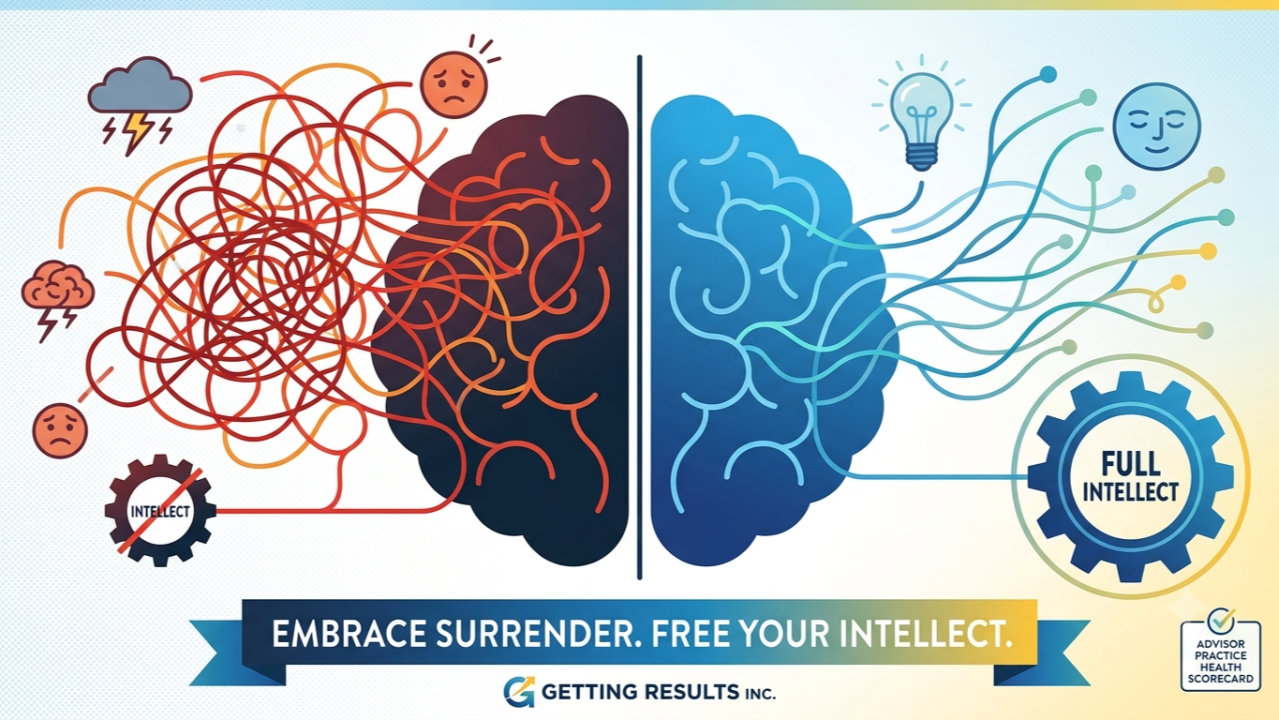

Recently, I spoke with a client who was contemplating an action for the betterment of his group although said action came with a bit of sacrifice on his part. Certainly, it’s better to deal with reality as it is rather than a reality we pretend it to be. That said, it’s easy to get caught up in a fabricated narrative without realizing that we’re caught in it. I had to remind this client that it was time to “Shrug, Atlas. If you are ready to sacrifice for the group, are you entirely clear that that’s necessary?”
The narrative in his head was that if he didn’t do “x,” everyone else would suffer. He was positioning himself as hero. Nothing wrong with that, but I wanted him to be sure he was “eyes wide open” about the action. Selfish as it may seem, I will suggest you always operate in your own self-interest because you can be sure everyone else is operating in theirs.
Keep eyes wide open in all things and at all times as much as possible. When you deal with reality as it is, you can properly allocate attention, time, and treasure. If the reality is a pretend one, you can be sure that attention, time, and treasure will be misallocated.
So how do you know if you’re dealing with reality as it is? One of the quickest ways to make this determination is to write stuff down. Get it out of your head and onto paper. Your current situation and your understanding of it become clearer once it’s out of your head. If you’re frustrated with yourself or perhaps a staff member or client, put it on paper. It helps you gain clarity. Ideally, you can also have a conversation with a coach to gain an outside perspective that you won’t get elsewhere.
The book Don’t Believe Everything You Think: Why Your Thinking Is the Beginning & End of Suffering by Joseph Nguyen addresses similar concepts. A thought is a noun, a thing. For the most part, thoughts are positive, but thinking is a different entity. Thinking can be the root of all suffering. Again, a thought is a noun, but thinking is a verb. A thought usually leads to thinking. For example, I want to get up at 5:00 a.m. – a thought, which leads to thinking: “What am I going to do when I get up?” And suddenly, “I don’t wanna” creeps in.
Don’t eliminate thinking, but stop thinking as much as you possibly can. If you have a bucket full of muddy water, the best and easiest way to clear it is to simply let it be and let it settle. Forget filters and distillation. Your mind works the same way. The more thinking you do, the more cluttered your mind becomes. The more thinking you do, the more negativity can arise. Like the bucket of muddy water, let your mind settle. Stop thinking.
Too much thinking, leads to overwhelm. When you’re overwhelmed, you’re focused inward and on self. It’s also an indicator of failure to prioritize and that it’s time to shrug, Atlas. Stress goes up, and stress and intelligence are inversely related. Honestly, creating regular time to let your mind settle is one of the greatest gifts you can give yourself.
There’s reality (it is what it is) and the definition we attach to it (what we imagine reality to be). Because it’s so easy to fail to keep eyes wide open about reality, discernment becomes paramount. Stop. Evaluate. Consider. Let your mind settle. Do not simply act.
SuperCoach
www.gettingresultsinc.com Complete as assessment and let’s have a structured conversation to help you go further and faster with less fuel.