
“It’s too woo-woo for my clients.” That’s the sentence that nearly cost one of our advisors a ten-million-dollar relationship before it ever had the chance to exist. She had an idea to co-host a
retreat with a longtime center of influence. She killed it in her own head before a single client ever weighed in, because she’d already decided what they’d think.
I asked her the question I ask every time a client hands me a limiting belief dressed up as a fact: have your clients actually told you this, or is this a story you’re telling yourself?
Silence. Because no client had said a word. She’d written the whole script, cast her own clients in it, and then let the fictional audience talk her out of a real opportunity.
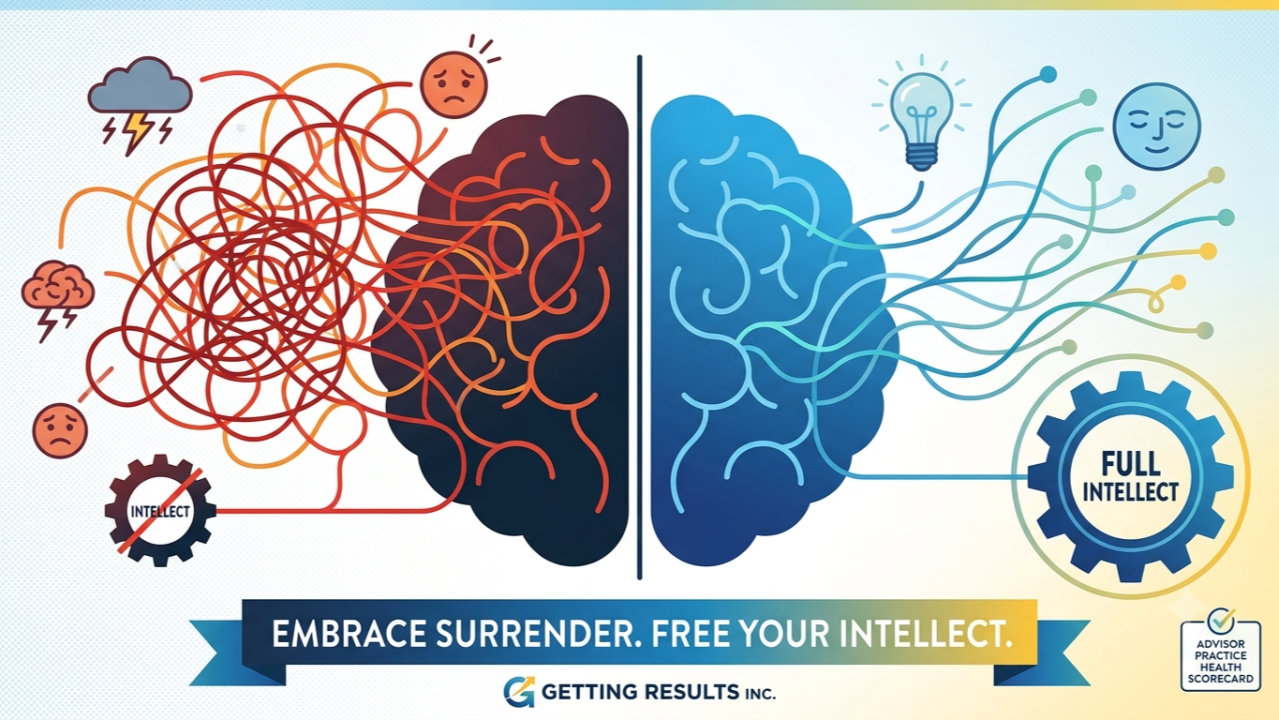
I’ve written about this exact mechanism before, just from a different angle, in Distorting Reality whacks productivity. Watch for the words always, never, everybody, nobody. “Everybody has to see me right now.” “Nobody wants to see me.” “My clients would never go for that.” None of those statements are ever literally true, and the moment you say one, you’ve swapped reality for a story, and the story is almost always worse than the truth. Distorted reality spikes stress, and stress and intelligence are inversely related. You end up making decisions, or avoiding decisions, based on a fear you invented rather than any actual evidence in front of you.
This is close cousin to the fear I wrote about in I Don’t Want to Be Salesy: a story that feels protective but is actually just resistance wearing a disguise. “I don’t want to be salesy” protects you from the discomfort of asking. “It’s too woo-woo” protects you from the discomfort of being seen as different. Both stories have the same fingerprints: nobody told you this, you told yourself this, and you believed it faster than you’d believe almost anything a client actually said out loud.
Here’s the part advisors don’t expect. Even after Paige got clear that the story wasn’t real, even after the retreat idea turned into an actual ten-million-dollar client, the self-doubt didn’t disappear. If anything, it got louder. That’s normal, and it’s worth naming so it doesn’t derail you: resistance is real, change is not easy, and all value is earned. Imposter syndrome after a real win isn’t a sign you don’t deserve it. It’s usually a sign you’re standing somewhere genuinely new, and the old story hasn’t caught up to the new evidence yet.
So the fix isn’t positive thinking. It’s a habit of interrogation. Every time you catch yourself building a case for why you can’t do something based on what your clients would supposedly think, stop and ask the real question before you accept it as fact: did they say that, or did I? If you can’t point to an actual conversation, you’re not protecting your business. You’re avoiding something, and avoidance always feels like prudence right up until you look back at what it cost you. If this pattern sounds familiar, the podcast on avoidance behaviors is worth twenty minutes of your next drive.
Here’s the exercise. Go find the idea you’ve shelved because you decided, unilaterally, that your clients wouldn’t be into it. Go ask one of them. Not a hundred. One will usually do it. Let reality answer the question instead of the story you’ve been telling yourself on repeat.
If you’re not sure whether it’s the story that’s holding you back or something more structural in the practice itself, get an honest read. The Advisor Practice Health Scorecard takes about five minutes and shows you exactly which of the four stages, Survival, Thrival, Mastery, or Purpose, you’re actually operating from. Take the Scorecard here.
Be wonderful.
Coach Ken
Complete our free personal assessment, and let’s have a structured conversation to help you go further and faster with less fuel.