
That tension you feel walking into a tough meeting? There’s good evidence it isn’t in the room at all, and knowing that changes how the meeting goes. If you’ve been searching for how to stop self-doubt in sales meetings, or how to feel confident in client meetings, this is where it starts.
On a recent coaches’ call I tossed the group a question I’ve been chewing on for weeks. Does tension exist outside of your skull?
Is the Tension Really in the Room?
Think about the last time you walked into a room and felt the tension. A tough prospect meeting. A review with a client whose portfolio is down. A room full of centers of influence who all seem to know each other already. You’d swear the tension was sitting right there on the conference table. Was it?
The Dartmouth Experiment: A Scar That Wasn’t There
There’s a well-known experiment from Dartmouth that I keep coming back to. Researchers told participants they were studying how people react to someone with a facial scar. A makeup artist gave each participant a realistic scar on the cheek and let them see it in a mirror. Then, just before the conversation with a stranger, the artist said they needed to apply a little moisturizer to keep the makeup from cracking. What they actually did was quietly wipe the scar away.
The participants walked into their conversations with no scar at all. Afterward, they reported that the stranger had been uncomfortable, a little tense, and kept looking at the scar. The scar wasn’t there. The judgment wasn’t there. They carried both of them into the room.
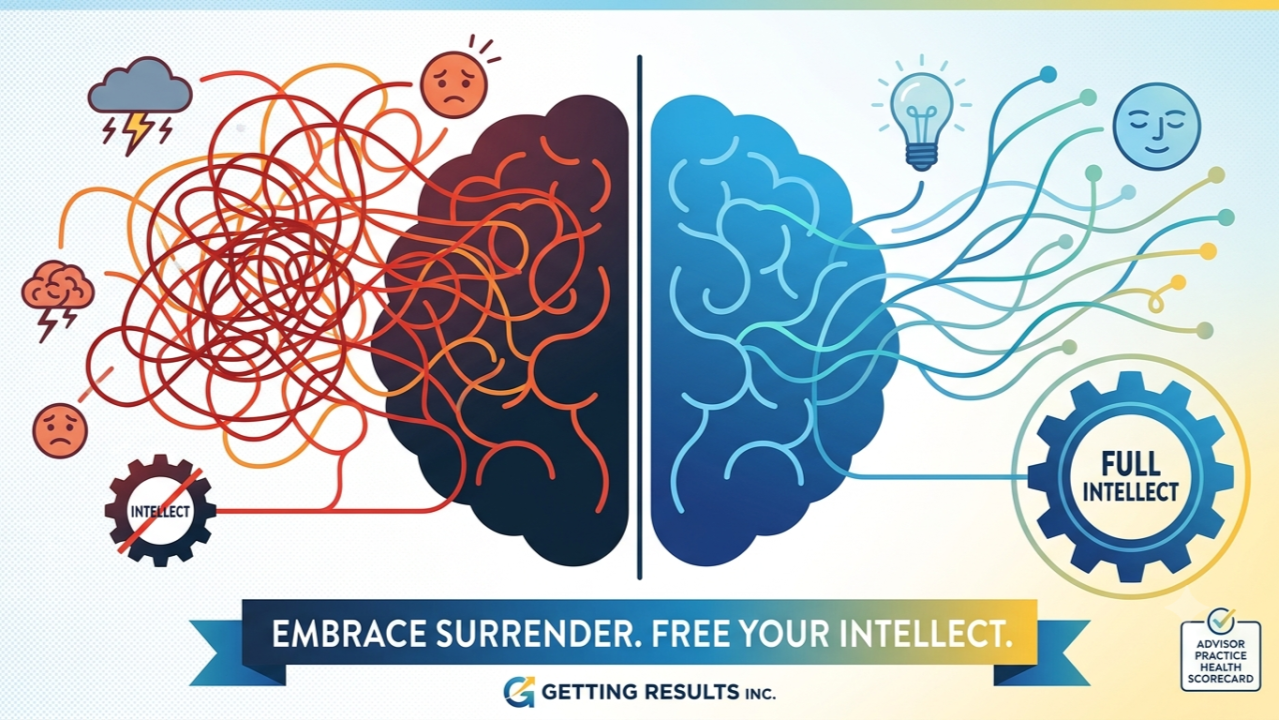
Tension doesn’t live in the room. It lives in your skull.
Every Financial Advisor Has A Scar Like This
Every financial advisor I have ever coached has a scar like this. Maybe it’s your age, the classic young financial advisor age bias, and you’re sure the 65-year-old business owner sees a kid. Maybe it’s the size of your book, or the name on your business card, or the fact that you didn’t come from money.
You walk in carrying it, and then you read every pause, every glance at a phone, every “let me think about it” as proof that they saw it too. That’s financial advisor imposter syndrome in its simplest form, and psychologists have a name for the habit behind it: the spotlight effect, our tendency to overestimate how much others are noticing us. In sales, the spotlight effect has you convinced the prospect is watching you, when they’re mostly thinking about themselves.
One of our coaches shared something on that same call. He’d been self-conscious about something for years and finally mentioned it to a few close friends. Every one of them said some version of the same thing: I don’t even notice it anymore. His conclusion was honest. It’s more in my head than anybody else’s.
There is no Objective Reality in the Meeting Room
Here’s the deeper point. There is no objective reality in that meeting room. That doesn’t mean trees don’t exist. Run into one and you’ll still get a concussion. But what the tree means, even whether you notice it at all, is happening inside your consciousness. Reality requires interpretation. And anything that requires interpretation raises a fair question. Is your interpretation correct?
What You Project, You Tend to Create?
This matters in your practice because what you project, you tend to create. The advisor who believes the prospect sees him as too young will over-explain, over-credential, and apologize with his body language. Now the prospect really does feel something off, and the story confirms itself. That’s why learning how to gain credibility with older clients starts with where your attention goes, not with another credential.
We explored how these self-made stories drain results in Distorting Reality Whacks Productivity.
Set the Scar Down
The answer isn’t to pretend you have no scars. It’s to notice that the scar is yours to carry or set down, and the person across the table mostly isn’t looking at it. They’re thinking about themselves: their money, their family, their worries. Which, frankly, is exactly where your attention belongs too. For more on this, listen to Your Mind…Is It Your Biggest Mess?
How to Overcome Imposter Syndrome as a Financial Advisor?
Write down the one thing you’re most sure your prospects judge you for. Then ask three people who know you well whether they notice it. Not whether it’s true, whether they notice it. Then walk into your next meeting having set it down at the door, and pay attention to what actually happens.
Financial Advisor Mindset Takes Structure, Not Just Insight
A shift in financial advisor mindset is easy to understand and hard to hold on to. You can have a great insight on Monday and be back in the old story by Friday. That’s where financial advisor coaching earns its keep: structure, community, and accountability that turn good intentions into results.
That’s the idea behind the Slight Edge Accelerator (S.E.A.), a 120-day system that turns the goals you keep restarting into outcomes you actually reach.